- Leveling Machine
- 4-high leveler machine
- 6-high precise leveler machine
- Leveler machine for special...
- Coil Straightening Machine
- Automatic high speed cut...
- 6-high Automatic cut to...
- Automatic tracking shear...
- Automatic rotary shear...
- Tension leveling line
- Automatic high speed cut...
- Thick Plate Decoiling...
- Automatic Slitting Machine...
- Slitting Line
- Slitting and cutting to length...
- Main parts
Leveler Machine Series
Production Line Series
Cutting Machine
Intelligent container...
Cylinders of shear...
- Wuxi Oriental Machinery Factory Co., LTD.
- Add:No. 50, Hongxiang Road, Hongshan Industrial Park, Wuxi City, Jiangsu Province
- Tel:86-510-88703103
- Fox:86-510-88213609-8008
- Jianwei.Tang 86-139-1533-8317
- Fan.Gao 86-159-6182-5555
| Utilizing the Effect of Leveling Machines |
| Update Time:2015/7/22 8:44:41 Clicks:8686 |
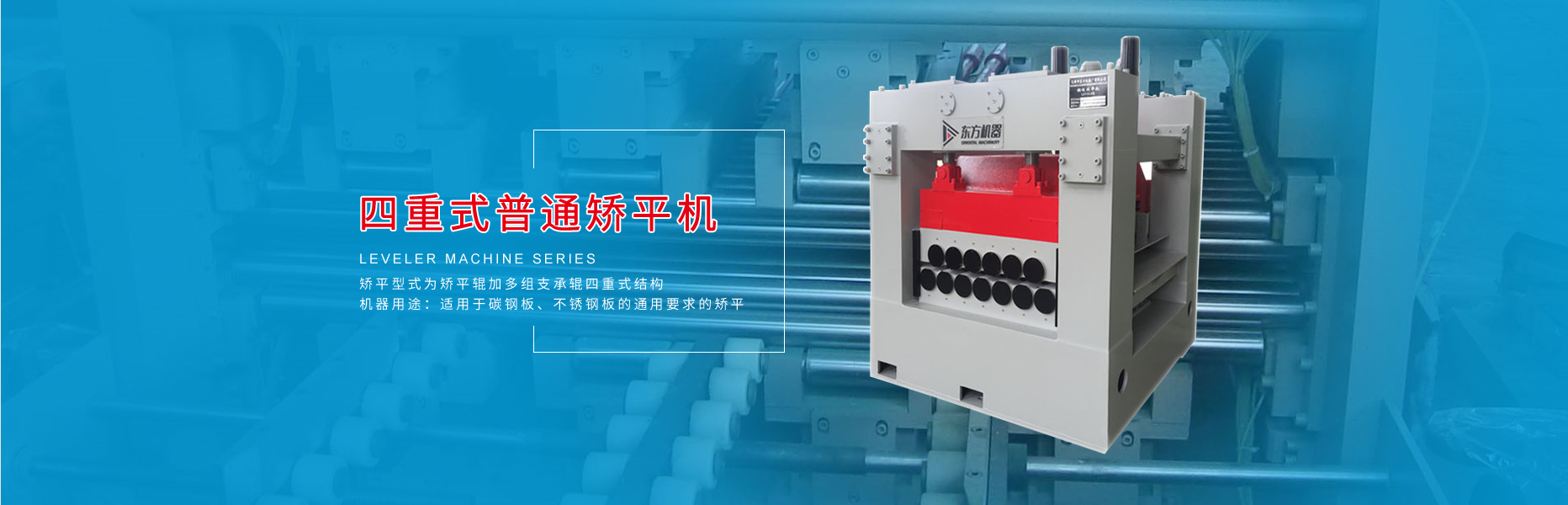
The roller-type plate leveling machine utilizes the Bauschinger Effect to repeatedly bend the plate in alternating directions, gradually converting multiple original curvatures into a single uniform curvature, thereby leveling the plate. This model adopts a non-parallel roll arrangement structure, meaning the upper and lower rows of work rolls are staggered, and the upper row of work rolls features a tilting function — it can tilt at an angle relative to the lower row. The gap between the rolls gradually increases from the entry side to the opening side. In this way, as the steel plate being leveled is sequentially fed into the work rolls of the leveling machine, the bending curvature of the passing material gradually decreases. That is to say, the plate material at the entry side undergoes plastic deformation, and as the plate moves toward the exit side, its plastic deformation gradually diminishes until it reaches complete elastic deformation at the exit side. As the plate passes through the upper and lower work rolls, the Bauschinger Effect is utilized to subject the plate to multiple alternating forward and reverse bends, gradually converting multiple original curvatures into a single curvature. This reduces and evenly distributes the residual stress in the plate. At the same time, since all work rolls of this machine are drive rolls, the rolls downstream continuously exert a tensile force on the plate in the direction of the rolls, which helps eliminate internal stress in the plate. The deformation characteristics of this leveling process can more effectively correct irregular bending in plates, meeting the requirements of high-precision leveling principles.
A leveling machine is also known as a cut-to-length line, flattening machine, straightening machine, or correcting machine. The more formal name is plate leveling machine, but in everyday usage, people commonly refer to it simply as a "leveling machine" out of habit.
Leveling machines are suitable for leveling various types of cold-rolled and hot-rolled plates. Due to their convenient and simple operation, they are widely used across multiple industries, including machinery, metallurgy, building materials, chemicals, electronics, electrical equipment, and light industry. They are particularly indispensable in industries such as shipbuilding, locomotive and rolling stock, boilers and bridges, and metal structure factories, where they have become essential production equipment.
For more information about leveling machines, please visit http://www.dfjq.com
|
Total Pages:1 Page 1  |
| Previous Article:Master the Casting Requirements for Leveling Machines Next Article:Key Checks for Straightening Machine Operation |