
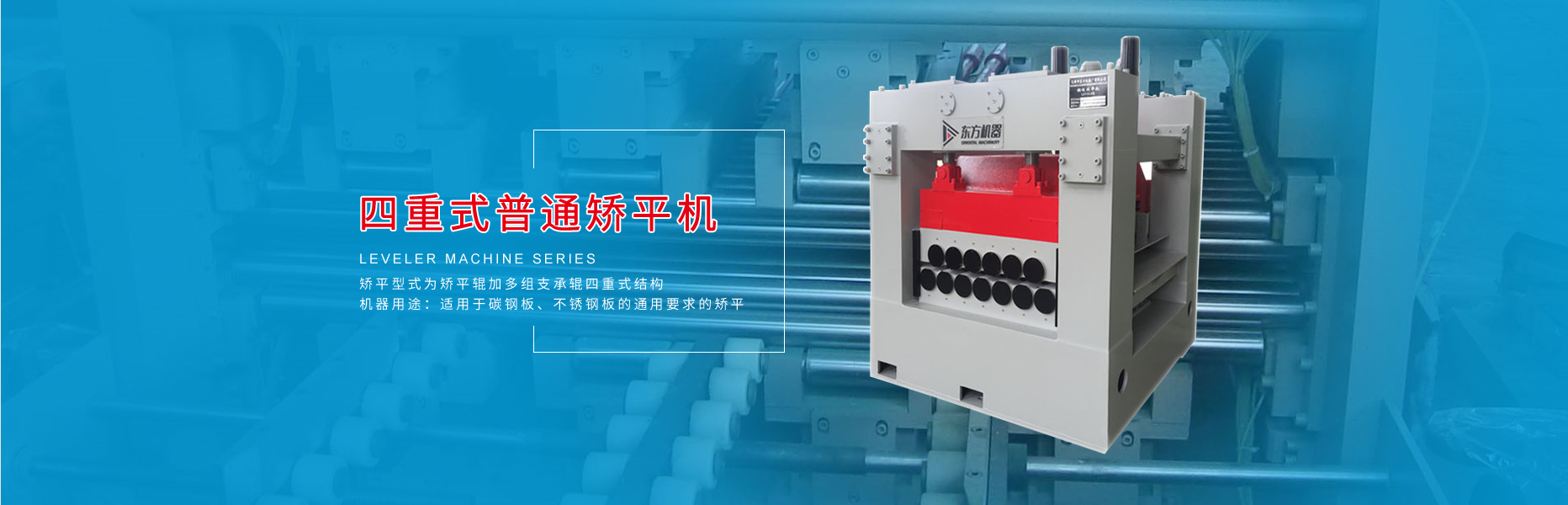
Featured Products
- Leveling Machine
- 4-high leveler machine
- 6-high precise leveler machine
- Leveler machine for special...
- Coil Straightening Machine
- Automatic high speed cut...
- 6-high Automatic cut to...
- Automatic tracking shear...
- Automatic rotary shear...
- Tension leveling line
- Automatic high speed cut...
- Thick Plate Decoiling...
- Automatic Slitting Machine...
- Slitting Line
- Slitting and cutting to length...
- Main parts
Leveler Machine Series
Production Line Series
Cutting Machine
Intelligent container...
Cylinders of shear...
Contact us
- Wuxi Oriental Machinery Factory Co., LTD.
- Add:No. 50, Hongxiang Road, Hongshan Industrial Park, Wuxi City, Jiangsu Province
- Tel:86-510-88703103
- Fox:86-510-88213609-8008
- Jianwei.Tang 86-139-1533-8317
- Fan.Gao 86-159-6182-5555
| How to improve the precision of a steel plate cut-to-length line! |
| Update Time:2022/11/28 21:04:01 Clicks:9844 |
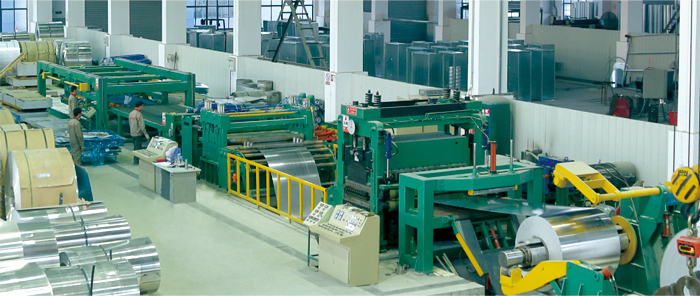
The steel plate cut-to-length (CTL) machine is a crucial piece of equipment on a decoiling line. The number of cutting strokes of the CTL machine largely determines the overall productivity of the decoiling line. Generally speaking, the CTL machines used in decoiling lines differ from standard steel plate CTL machines due to the following special requirements:
(1) High Productivity
For a decoiling line processing 3mm thick plates, the requirement is 30 to 35 cuts per minute for a fixed length of 2000mm, and 80 cuts per minute for lengths under 500mm. Such high productivity cannot be achieved by general-purpose shearing machines.
(2) Full Load Operation
Many decoiling line users operate on a 2- to 3-shift system, requiring the steel plate CTL machine to perform 10,000 to 20,000 cuts daily. Standard steel plate CTL machines are not designed to withstand such heavy-duty continuous operation.
(3) High Reliability
If the CTL machine in a decoiling line breaks down, the entire line must halt. For users like automotive plants, the downtime of a single decoiling line can also cause several stamping lines to shut down. Therefore, the CTL machine must have the lowest possible failure rate, and troubleshooting must be straightforward.
(4) Diversity of Coil Materials
General-purpose steel plate CTL machines determine their cutting force based on standard carbon steel. However, coil materials vary widely, ranging from lower-strength galvanized steel, tinplate, color-coated steel, and aluminum, to high-strength stainless steel, weathering steel, and pickled steel. Coils used in automobile production include uncoated cold-rolled steel, hot-rolled pickled steel, high-strength cold-rolled steel, high-strength galvanized steel, single- or double-sided electrolytically coated steel, single- or double-sided hot-dip galvanized steel, and aluminum. Since users often cannot provide the exact mechanical properties of the processed materials, the application range of the machine must be fully considered during its design and selection.
 (5) Special Shearing Methods
To prevent burrs from scratching the surface of the plates during stacking, some decoiling lines require the burrs to face upwards. Therefore, the cutting frame of the steel plate CTL machine must shear from bottom to top. This type of machine is known as a bottom-cutting CTL machine. After shearing, the plates fall onto a moving conveyor belt. To prevent them from skewing, the blades on the cutting frame are designed in a herringbone (chevron) shape, which is especially necessary for plates with shorter cut lengths.
In summary, standard steel plate CTL machines cannot meet the rigorous demands of decoiling lines; dedicated machines must be designed. The steel plate CTL machines produced by Wuxi Dongfang Machinery feature significantly greater strength, stiffness reserves, and energy reserves compared to standard models. Breaking through certain traditional design concepts of standard CTL machines is essential to ensure that dedicated machines can better satisfy the production requirements of decoiling lines.
|
Total Pages:1 Page 1  |
| Previous: None Next Article:Cut-to-Length Line Process Flow and Operational Precautions in Production! |